Integrative Psychotherapy & Counselling
A confidential space to be truly heard
Psychotherapy & counselling for individuals, couples and groups in Hampstead, North West London — and online.
Psychotherapy & Counselling for Individuals, Couples and Groups in Hampstead / Online
Over the last two decades I have been an Integrative psychotherapist and counsellor seeing individuals, couples and groups at the Priory Hospital, the NHS, Tavistock Relationships and in my consulting rooms in Hampstead, North West London. I am committed to providing psychotherapy and counselling to clients from diverse backgrounds, on an open-ended basis or for an agreed time period, in a safe, confidential environment. I listen with sensitivity and empathy — and without judgement. In the therapy space thoughts and feelings can be expressed freely.
I embrace an attitude that affirms the inherent value of each individual, and offer a flexible yet pragmatic approach. Being integrative, I draw on many therapeutic disciplines, such as the in-depth awareness focused approaches inspired by transpersonal and depth psychology, as well as the solution focus inherent in cognitive approaches and the creative aspects of art and drama therapy. This means that I call upon an extensive range of maps, models and understanding from various theoretical systems. Each provides its own valuable perspective and is enhanced when carefully integrated with another.
The term ‘integrative’ also refers to the process of integrating the personality, taking disowned aspects of the self and bringing them into awareness, therefore reducing the need for self-defeating defence mechanisms and behaviour.

Individual Therapy
Individual Psychotherapy and Counselling for Adults
With the aim of enabling you to enhance your quality of life and relationships, I am experienced in helping clients who have struggled with a wide range of difficulties — whatever has brought you here, you are welcome.

Couple & Relationship Therapy
Couple Counselling North West London

Relationship Counselling and Psychotherapy
Relationships are an essential part of our lives, from family and friends to partners and spouses. We have a natural tendency to develop intimate and intense relationships with a few select individuals, which can bring joy and happiness. Difficulties in relationships are one of the most common causes of unhappiness, and often bring people into therapy.
Relationship counselling can help you whether you’re young or old, straight or gay, single or in a relationship. Lots of people have an idea of what relationship counselling is and think that you only need counselling when things get really bad. But even if your problems seem trivial, relationship counselling can help.
The reasons for seeking relationship therapy include:
How can Relationship Counselling help me?
It really depends what you want to get out of it, but it’s rare that you will leave counselling without feeling a positive change. For some people, counselling transforms their relationships and their lives; for others it helps them solve a specific problem and move forward with more confidence and less anxiety.
Each session usually lasts 50 minutes, and you’ll be asked questions so that you can talk about what’s going on and how you feel. You may be offered different perspectives or ideas to try at home. If you don’t like to talk a lot then your counsellor might try different things like drawing or mapping out your thoughts. It all depends on what’s right for you. Even if things don’t change, counselling may help you to see things in a different way or make the decision that’s right for you to move forward. Just talking to someone who isn’t involved in the relationship can help you. People are genuinely surprised when we start working together – they think that I’m going to tell them what to do, but it’s not like that. They also come in feeling nervous and apprehensive but once we have met a few times, they start to enjoy it. At the end of the day, it’s a brave move to come to counselling, but for almost everyone, it’s one of the best moves they have made.
Couple therapy offers a safe and confidential environment where individuals and couples can explore their relationship concerns with an experienced, professional therapist. By helping you to identify the roots of your difficulties, relationship counselling brings clarity and facilitates positive change.
Group Analysis
Benefits of Group Analysis for Individuals and for Couples
The process of therapy is about human relationships. The goals of therapy are about resolving the blocks to mature emotional functioning; achieving the capacity ‘to love and to work’. Difficulties with this can lead to loneliness, anxiety and a range of other issues. In group analytic psychotherapy, heterogeneous groups maximise learning opportunities by providing a richer range of relationships and ‘mirrors’ to support, challenge and learn from each other in a confidential setting. The reciprocal relationships developed in a group over time foster a sense of trust and belonging, which allows for intimacy and conflict to be negotiated, often for the first time. As relationships deepen in the group, so this is inevitably mirrored in relationships beyond the group.
In what might feel as an isolated and dislocated world, it can feel unfamiliar and intimidating to share private thoughts and experiences with strangers. However, the experience of coming together on a regular basis leads to feeling less alone. Learning about yourself and others leads to understanding and empathy, resulting in a feeling of connection as well as a more joyous way of being in the world.
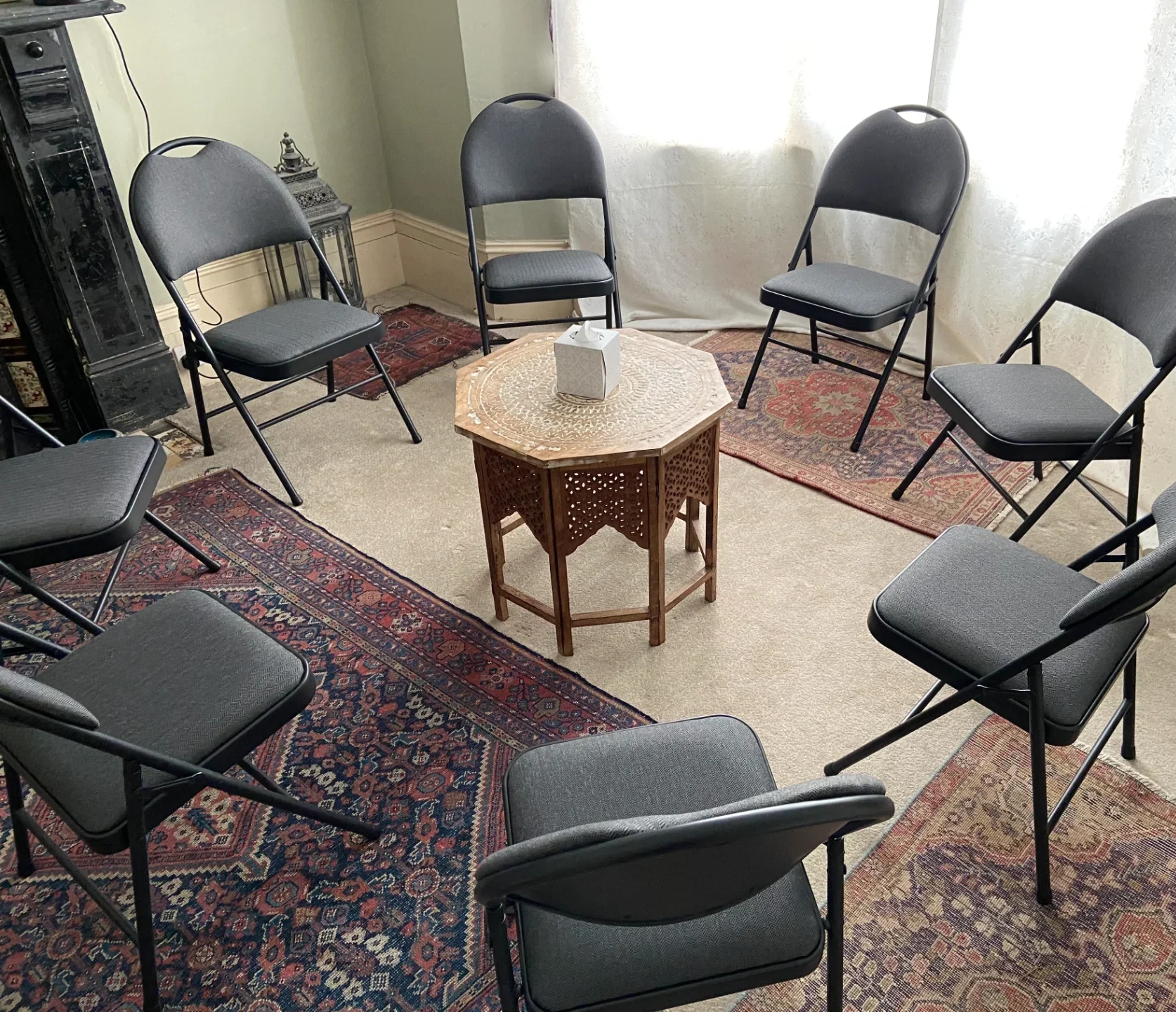
I run Group Analytic groups for up to eight individuals, meeting for ninety minutes either once-weekly or twice-weekly for deeper work. The couples groups consist of up to four couples. Self Reflective Groups for professionals are useful for processing work related stress or trauma.
Once-weekly analytic therapy group
Mondays 7.30am – 9am · or Tuesdays 6pm – 7.30pm
Enables a confidential setting for exploring personal and professional concerns, wherein trust is developed so that you can become aware of how you experience others as well as how you are experienced by them. This increased awareness of relationship patterns facilitates long-lasting and creative change that enables deeper and more meaningful relationships both inside and consequently outside of the group. The group is particularly relevant if you struggle with forming close relationships, feel isolated or lacking in confidence and wish to find ways of connecting authentically – both to yourself and those around you.
Twice-weekly analytic therapy group
Tuesdays & Wednesdays 7.30am – 9am · or Mondays & Wednesdays 6pm – 7.30pm
The increased regularity of the twice-weekly setting can allow for a richer examination of relationship dynamics pertaining to issues surrounding trust and intimacy. The added support and challenges in a twice-weekly group can speed up the process of change.
Further Benefits of Group Analytic Groups
In a well-functioning analytic group, each member discovers their inner world and discerns how it colours their view of others, and their inner worlds. This promotes the recognition that others are not just objects to be desired or feared, but people with their own valid viewpoints and feelings. Similarities and differences can then be clarified and respected, as stereotyping and projections are reduced, transference distortions based on internal object relationships as well as illusions are exposed and modified through intersubjective validation, and prejudices transcended towards mutual empathy. Individuals then become less defensively self-absorbed.
In individual therapy empathy is the prerogative of the analyst, who then has to rely on changes in the patient’s transference, and his or her reports of changes in relationships outside the treatment setting. The group setting not only provides the opportunity for observing others in interaction, and of having oneself observed in interaction with others, but also models the triangulation that is the basis of both Oedipal and social development. Groups can help people who have become stuck in individual analyses, as harmful unconscious collusions and misunderstandings between individual patient and therapist can be observed and challenged by others.
Our need to cling to the internal object relationship is a source of severe resistance in analysis. This often becomes clear in the matrix of the analytic group as a shared problem. What do we do if our sense of self and safety, or that of another group member, depends on maintaining, for instance, the role of victim or of omnipotent controller, of independent coper or entertainer? These and other roles can block the development of the individual or group. For example, mature dependence may fail to replace infantile dependence or counter-dependence.
Our experience in the family continues to influence perception of outside relationships, largely unconsciously, so that inner and outer worlds resonate and mutually recreate each other in repetitive patterns with significant others beyond the family. The significance of each person to the other, and thus the nature and quality of the subjective feelings and phantasies evoked by the interaction at any point in time, or the group matrix within, will depend on the total configuration of relationships within the system — of understanding the multi-personal psychological field. Groups provide transformational, transitional and reparational functions for the individual. They also act as links with sociocultural norms and values, with the world outside the family.
Groups provide a sense of belonging, an identification through membership of groups that give one a continuing sense of ‘we-ness’. This can be taken for granted until groups — and their function for the individual — are disrupted by migration or relational difficulties.
Common Questions About Groups
People in groups don’t come with the same problems
They may struggle with loneliness, family issues, relationships, work, social concerns, anxiety, loss, bereavement, depression or a wish to have a better life.
What happens if I know someone in the group?
Many people worry about this but it rarely happens. We do our best to ensure you don’t know the other group members. In the unlikely event that you discover you know someone, we will work through this together in the group.
There is no set topic or agenda for each group
Group members bring whatever comes to mind, past or present, including what is happening in the group.
The group provides a confidential space
Confidentiality is an important part of creating a sense of safety. Feeling alone in one’s distress is alleviated by witnessing others with similar problems. A group provides a sense of belonging, and the opportunity to realise that others share both our strengths and our difficulties.
Overcoming feeling daunted by the idea of talking in front of others
Many people worry about feeling daunted by speaking in front of others, but then experience a sense of relief when they join a group and find that others have struggled with this concern but have found a way to overcome it. It takes time, there is no pressure; you go at your own pace.
“The curious paradox is that when I accept myself just as I am, then I can change.”
Carl Rogers
Taking the first step
Once you have decided to consider therapy, I recommend an Initial Consultation where, together, we can think about your goals and see how it feels to work together. I warmly welcome both self-funding and insured patients.